The AAFA conference

07/01/2025 - 16:51

The AAFA (American Apparel & Footwear Association) event in Ho Chi Minh City, held on December 11, 2024, was a comprehensive conference focused on compliance and regulatory challenges in the apparel and footwear industry.

Colin Browne, CEO of Cascale, have the keynote Address provided insights into the global compliance landscape and Nate Herman and Chelsea Murtha, Senior Director of Sustainability, AAFA, discussed U.S. and European compliance trends, including environmental, chemical, and labor rights regulations. The event underscored the importance of aligning factory operations with U.S. brand expectations, fostering strong relationships, and ensuring ethical and legal compliance.
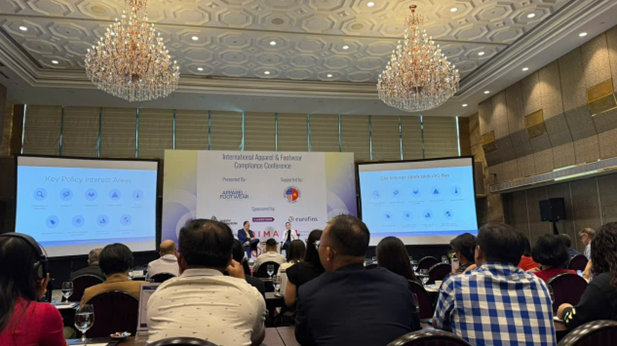
In addition, there is a requirement for reporting prohibited compounds PFAS, Bisphenols A/S (BPA & BPS) in the textile industry; the importance of traceability and and the problem of minimizing environmental footprint by converting DPPA renewable energy in Vietnam today.

This gathering served as a critical platform for sharing actionable insights and strategies to advance operations smartly and ethically in the apparel and footwear industry.

05/04/2026 18
The Vietnamese garment industry plays a significant role in the global supply chain, yet it faces immense pressure from commitments to reduce greenhouse gas emissions and the increasing demand for transparency from international customers. In the journey towards sustainable development, two key tools that help businesses maintain their competitive advantage are the Greenhouse Gas Inventory (GHG Inventory) and the Science-Based Targets initiative (SBTi).
Find out more
29/03/2026 17
The global textile industry currently emits about 4 billion tons of CO₂ annually, accounting for 10% of global greenhouse gas emissions (ClimateSeed, 2024). Vietnam is one of the leading garment exporters with a revenue of USD 44 billion, an 11% growth rate, and is the world’s second-largest textile exporter. This puts increasing pressure on the industry due to international climate commitments and environmental standards, particularly from the EU and the US. In this context, building a green supply chain becomes the key for the textile industry to maintain growth while meeting sustainability demands.
Find out more
23/03/2026 16
In addition to electricity, many factories rely on fossil fuels to power their production processes, especially in processes that involve heating, steam generation, or running generators. The most commonly used fossil fuels include:
Find out more
15/03/2026 19
The Vietnamese textile industry plays a critical role in the global supply chain, but it is also facing increasing pressure from greenhouse gas (GHG) reduction commitments and transparency requirements from international buyers. In the journey toward sustainable development, two core tools that help businesses maintain a competitive advantage are Greenhouse Gas (GHG) Inventory and the Science Based Targets initiative (SBTi).
Find out more
06/09/2022 282
Climate change is considered the number one threat for the future of our planet. To take concrete steps in the direction of mitigating climate change, we need sound standards and methodologies to quantify the impacts of our actions. There are a number of different standards to quantify the carbon footprint of products, each best suited for specific applications and target audiences despite efforts to harmonize them. In this article, we take you through the most important standards and methodologies and give you some step-by-step guidance for choosing the right one for your application.
Find out more
06/09/2022 282
Since 1950, the world has produced 8 billion tons of plastic, and recycled only 9% of it. About 12% has been incinerated, while the rest — around 79% — has accumulated in landfills, dumps or the natural environment. As it stands, just 2% of the world’s plastic packaging comes from recycled sources. Statistics like these are shocking, but they don’t mean we’ve reached the point of no return.
Find out more
21/07/2022 205
The basic principle of sustainable agriculture is the maintenance of a balance between the demands for food production and the preservation of our natural environment. Sustainable agriculture therefore is a type of farming that focuses on producing sustainable agricultural products without compromising the ability of current or future generations to meet their needs.
Find out more
CONNECT WITH US
CONNECT WITH US
CONNECT WITH US

JOIN ME ON MY GLOBAL CONNECTION MISSION
OUR JOB OFFERS
CGLOBAL VERIFICATION AND CERTIFICATION PTE. LTD.
CGLOBAL